





What is the working principle of the automatic plate rolling machine of CNC four-roll plate rolling machine?
The automated plate rolling process of the CNC four-roll plate rolling machine, and its ease of operation and stability compared to three-roll machines, stems from its unique system design. The four-roll structure, through optimized mechanical layout and control logic, achieves fully controllable alignment, clamping, pre-bending, and rolling of the plate, making it an ideal solution for efficient cylindrical forming. For purchasing agents and factory managers, understanding this principle is a crucial prerequisite for accurately assessing equipment performance and production efficiency.
Basic Structure of CNC Four-Roll Plate Rolling Machine
The automatic rolling principle of a CNC four-roll plate rolling machine begins with the clear division of labor among the rolls: the upper roll drives the rotation, the lower roll clamps and positions the plate, and the side rolls control the bending radius—they are not only supportive but also the core of transforming flat plates into curved surfaces. It is the active control of curvature by the side rolls that gives the four-roll machine a precision far exceeding that of simple roller devices in its automatic plate rolling function.
Flatbed alignment
The key to the ease of operation of four-roll plate bending machines lies in their superior plate alignment capabilities. In a CNC four-roll system, the plate is firmly clamped between the upper and lower rolls at the beginning of processing. This clamping action ensures that the material remains under control throughout the entire rolling process, effectively preventing lateral deviation. This means the machine can easily achieve alignment and keep the centerline stable from start to finish—an advantage that is particularly evident when processing long or heavy plates.
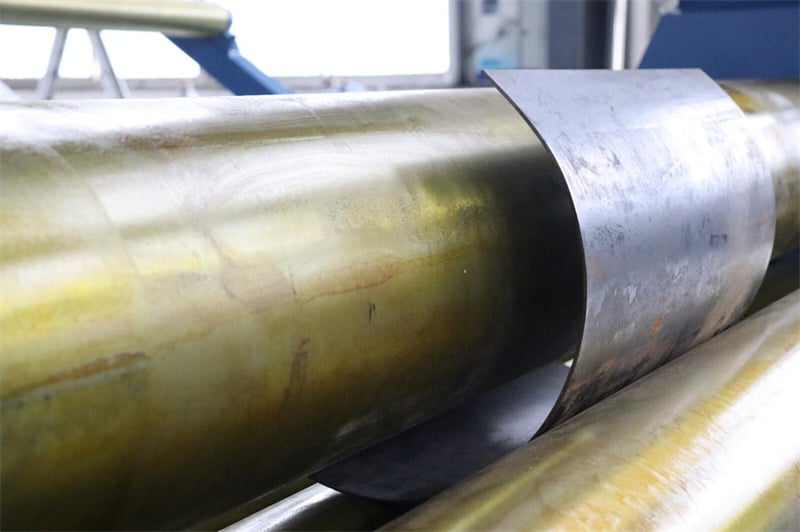
Pre-bending principle
Pre-bending is crucial because it determines the forming quality of the cylinder's ends. Without pre-bending, straight sections will remain at both ends of the sheet metal, becoming a burden for subsequent processing. The unique feature of a four-roll plate bending machine is that it can perform pre-bending at both ends before and after the main rolling, thereby minimizing the residual straight edges. In contrast, traditional three-roll mills often struggle to achieve this. This is precisely the secret to the four-roll system's ability to produce more regular cylinders—from a forming efficiency perspective, the pre-bending function reduces correction steps, truly enabling automated production.
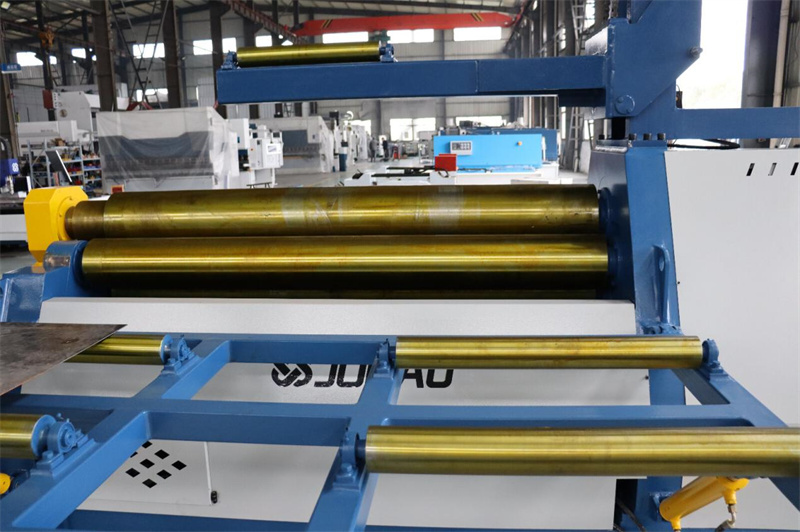
Continuous rolling process
The main rolling stage follows a simple logic: the side rolls gradually move upwards, driving the sheet metal to continuously bend, increasing the curvature until it is shaped into the desired cylinder. Its core technology is progressive plastic deformation—the sheet metal passes continuously between the rolls, gradually accumulating curvature, rather than being forcibly shaped in one go. It is this controllable path control that allows the four-roll plate bending machine to achieve stable rolling without human intervention. For users, this means the equipment operates in a "guided" rather than "forced" manner, thus ensuring accuracy and repeatability.
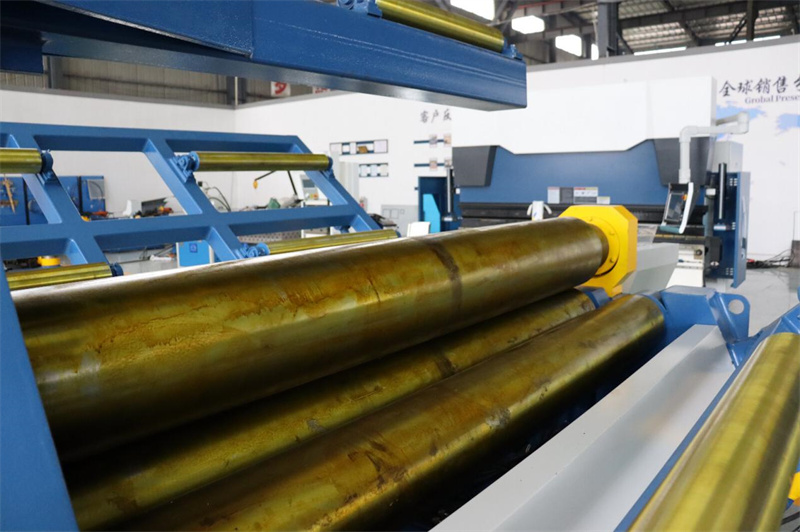
Eliminate flat ends
After the main rolling, the trailing edge of the sheet often retains a straight section. The purpose of reverse rolling is to eliminate this defect through secondary bending, thereby improving the overall roundness of the cylinder. Many customers initially do not understand why reverse rolling is necessary, but the principle is simple—to make the joints fit better and the forming more perfect. This is precisely why four-roll plate bending machines are highly favored in applications with high requirements for roundness and joint quality.
Precision control and compensation
Good rolling results depend not only on machine power but also, and perhaps more importantly, on a precise control system. In a CNC four-roll plate bending machine, forming accuracy is primarily determined by three factors: roller displacement determines the forming geometry; hydraulic control ensures stable and repeatable operation; and compensation adjustment corrects differences between the two sides of the machine. In actual production, uneven seam gaps are often a direct manifestation of the problem—if one side of the shell closes more tightly, it usually means the rollers are not perfectly parallel, or the displacement of the inclined side is mismatched with the fixed side. At this point, the compensation mechanism comes into play: by adjusting the relative positions of the rollers, system balance is restored, thereby improving rolling accuracy. This is the core of an automated rolling system—performance stems from controlled geometry, not just hydraulics.
Why is manual trial rolling necessary for automatic rolling stills?
The automatic rolling process of a CNC four-roll plate bending machine doesn't involve automatically calculating the trajectory as one might imagine. Instead, it follows a simple logic of "manual trial rolling → recording positions → saving the program → automatic repetition." The operator first manually rolls the plate to find the appropriate roller displacement for the current material. After the control system records these positions, the machine can accurately reproduce this successful path. In short, automatic rolling = automatic repetition of a proven solution. This is crucial for the user: the machine doesn't automatically generate parameters; it requires you to provide the correct program for stable and efficient operation.

