





Welding Robot Programming Techniques
The use of welding robots represents a further improvement in my country's
industrial welding technology. Robotic production has become a major development
trend, therefore, workers must strive to improve their professional knowledge of
welding robots. Welding is indispensable in many industrial processing fields,
such as automobile manufacturing and shipbuilding. Welding is very harmful to
the human body, and the working environment is extremely harsh. However, the
invention of welding robots can solve this problem. Many people may find this a
very complex topic, so let's briefly discuss robot welding programming
techniques.
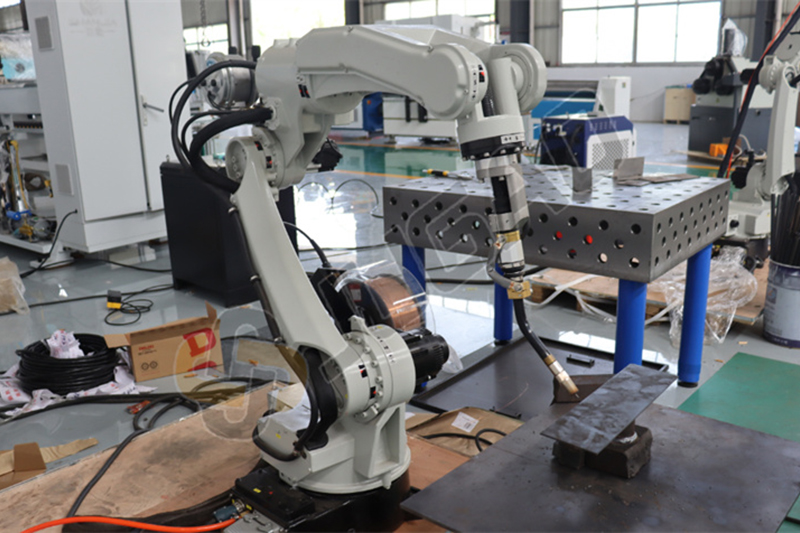
The programming quality of welding robots directly affects welding efficiency and weld formation quality. This article, combining industry technical specifications and practical experience, systematically explains welding robot programming techniques, covering teach programming, offline programming, trajectory optimization, parameter settings, and advanced function applications.
Welding robot programming techniques can be summarized as follows:
1. Choose a reasonable welding sequence to reduce welding deformation and the length of the welding torch travel path.
2. The welding torch spatial transition requires a short, smooth, and safe movement trajectory.
3. Optimize welding parameters. To obtain the best welding parameters, create working specimens for welding tests and process evaluation.
Arc Initiation Gradual Change: During the arc initiation phase, the current gradually increases to the set value over 0.5-1.0 seconds to avoid arc initiation impact.
Arch Termination Gradual Change: During the arc termination phase, the current gradually decreases to fill the crater over 0.5-1.5 seconds.
Interlayer Parameter Adjustment: Use a low current for the bottom layer (to reduce the risk of insufficient penetration), increase the current for the filler layer, and appropriately reduce the speed for the cover layer to ensure proper formation.
4. Employ reasonable positioner positioning, welding torch posture, and welding torch position relative to the joint. After the workpiece is fixed on the positioner, if the weld seam is not in the ideal position and angle, the positioner must be continuously adjusted during programming to ensure that the weld seam reaches a horizontal position sequentially according to the welding sequence. Simultaneously, the robot's axis positions must be continuously adjusted to reasonably determine the welding torch position, angle, and wire extension length relative to the joint. After the workpiece position is determined, the welding torch position relative to the joint must be observed visually by the programmer, which is quite difficult. This requires the programmer to be adept at summarizing and accumulating experience.
5. Insert a torch cleaning program promptly. After writing a welding program of a certain length, a torch cleaning program should be inserted promptly. This prevents welding spatter from clogging the welding nozzle and contact tip, ensures torch cleanliness, extends nozzle life, ensures reliable arc ignition, and reduces welding spatter.
6. Programming should generally not be done in one step. It requires continuous testing and modification during robotic welding, adjusting welding parameters and torch posture, etc., to create a good program.
The welding torch posture is crucial to the molten pool shape and weld formation:
Welding Angle: A 70°-80° angle between the welding torch and the workpiece surface is generally recommended (push welding) or a 10°-20° angle (pull welding), adjusted according to plate thickness and position.
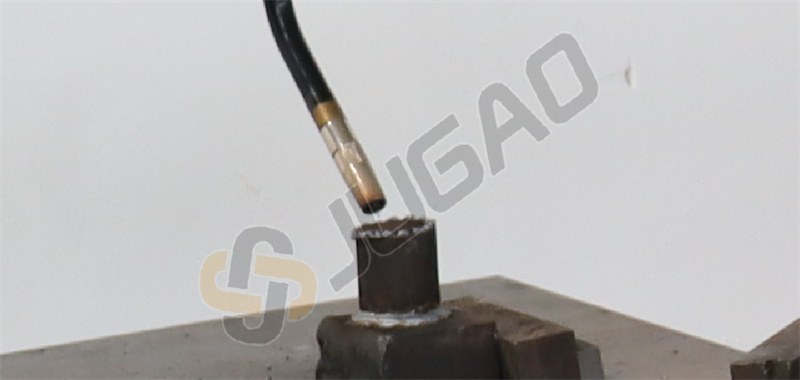
Posture Interpolation: For complex curved welds, a quaternion-based spherical linear interpolation method is used to perform posture interpolation within the neighborhood of the teaching point. This maximizes the smoothness of the welding torch movement and improves weld quality.
Interference Avoidance: A safe distance must be maintained between the welding torch and the workpiece during teaching to avoid collisions. A safety gap of 5-10mm is typically set.
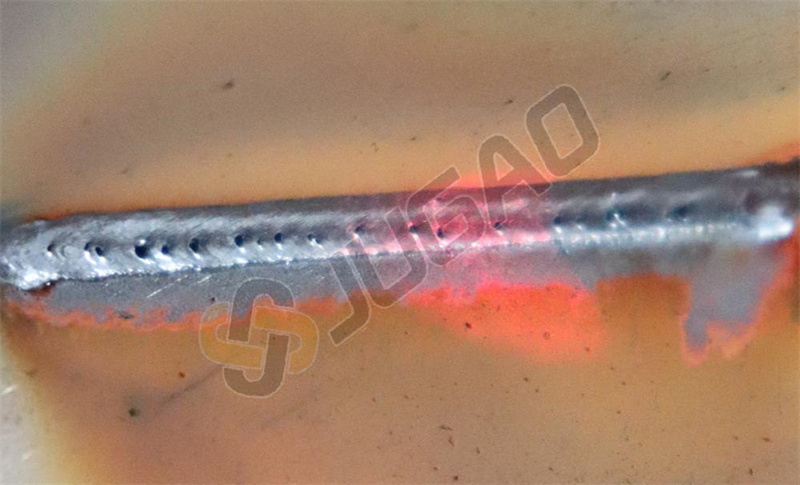
These are the programming techniques for welding robots. Welding robots can ensure consistent product quality from start to finish and keep workers away from harsh working environments, thus protecting worker safety, which is highly beneficial for enterprise development.

