





The Difference Between Welding Robot Positioning Accuracy and Repeatability
Repeatability (RT) of a Robot: The degree of consistency in the actual trajectory when the same commanded trajectory is repeated n times.
For example: If you require the robot to move 100 mm, and the robot moves 100.01 mm the first time, and then moves 99.99 mm the second time, the error of 0.02 mm is the repeatability.
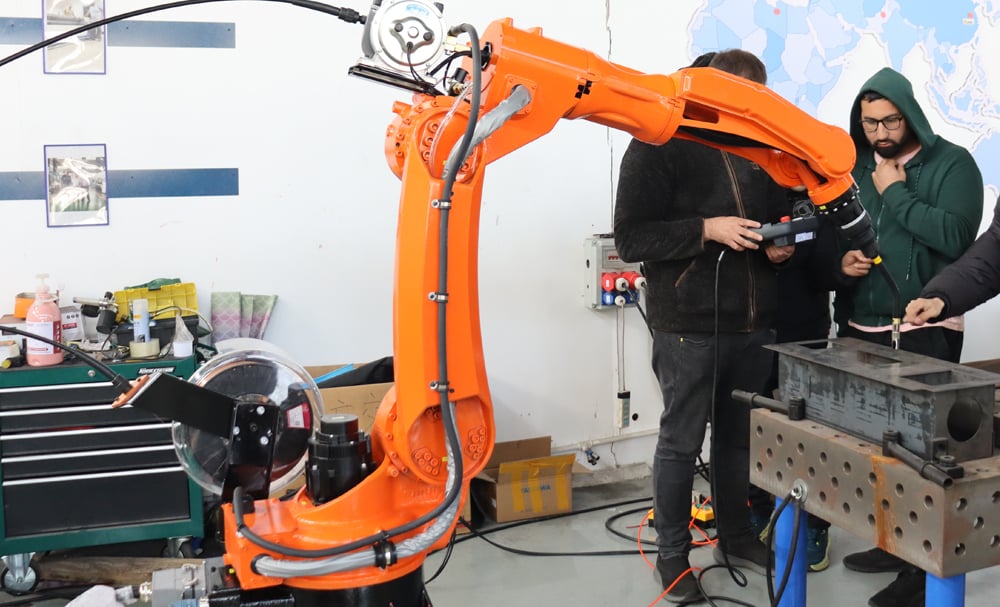
Positioning Accuracy (RP) of a Robot:
The degree of consistency in the actual pose after responding to the same commanded pose n times from the same direction.
For example: If you require the robot to move 100 mm, and it actually moves 100.01 mm, the extra 0.01 mm is the positioning accuracy.
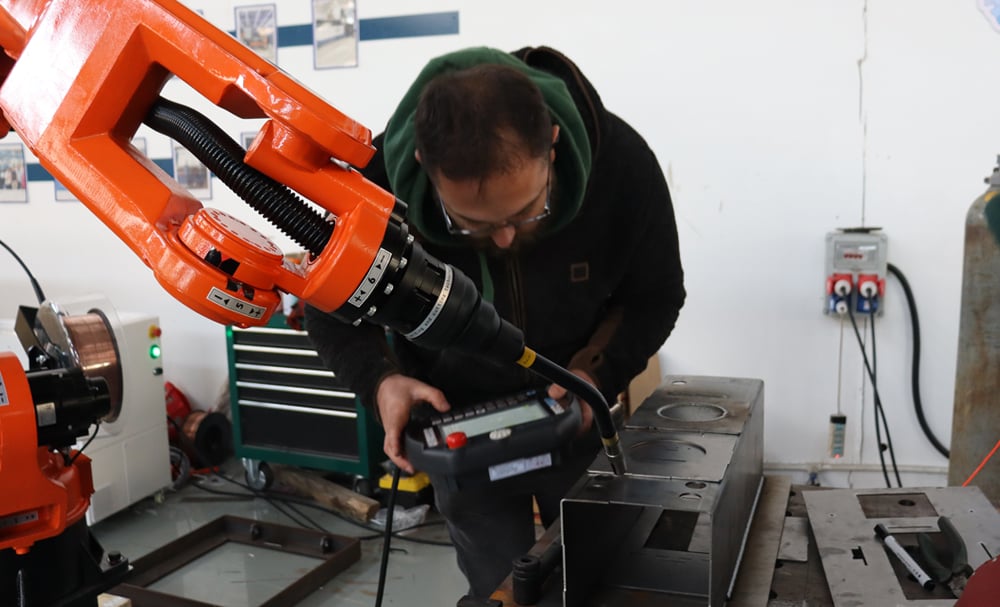
Generally, repeatability is much higher than positioning accuracy.
Robot Core Performance Indicators and Testing Methods
The standard specifies 14 key performance indicators and their corresponding test methods:
1. Pose Accuracy: Deviation between the actual end-effector pose and the target pose.
2. Pose Repeatability: Consistency of pose when reaching the same target multiple times.
3. Multi-directional Pose Accuracy Variation: Difference in accuracy when moving to the same target from different directions.
4. Distance Accuracy/Repeatability: Deviation and consistency between the actual distance traveled between two points and the commanded distance.
5. Position Settlement Time: The shortest time to stabilize within the allowable error after reaching the target.
6. Position Overshoot: The maximum overshoot distance before reaching the target.
7. Pose Characteristic Drift: Change in pose accuracy after long-term operation.
8. Interchangeability: Performance consistency after interchangeability of robots of the same model.
9. Trajectory Accuracy/Repeatability: Deviation between the actual trajectory and the expected trajectory, and consistency of multiple trajectories.
10. Repeated Orientation Trajectory Accuracy: Consistency of trajectory accuracy after changing the end-effector orientation.
11. **Corner Deviation:** The deviation between the actual trajectory and the commanded trajectory at a path corner.
12. **Trajectory Speed Characteristics:** The speed accuracy and stability during trajectory execution.
13. **Minimum Positioning Time:** The shortest time from startup to stabilization at the target pose.
14. **Static Compliance:** The displacement response of the end effector under static external forces (reflecting stiffness).
15. **Oblique Deviation:** The amplitude of end effector oscillation during motion (assessing stability).
Application Extension:
To achieve high-precision paths using robots, we can utilize auxiliary tooling and the robot's soft floating function. The auxiliary tooling corrects the path, while the robot provides power. For example, a guide rail slider can be used to achieve a high-precision path, with the robot providing the forward propulsion.

