





How to Maintain JUGAO Laser Cutting Machine Circuit Boards
Table of Contents
• Common Faults of Circuit Boards on JUGAO Laser Cutting Equipment
• Dust and Residue Buildup Issues
• Thermal Fatigue and Excessive Temperature Failures
• Harm from Power Surges and Circuit Overload
• Complete Step-by-Step Maintenance Guide for JUGAO Laser Cutting Circuit Boards
○ Step 1: Cut Off Power and Disconnect Power Supply
○ Step 2: Conduct Comprehensive Visual Inspection of Circuit Boards
○ Step 3: Safe Dust Removal and Board Cleaning Operations
○ Step 4: Full Inspection of Wiring and Plug-in Terminals
○ Step 5: Real-Time Supervision of Equipment Running Temperature
○ Step 6: Post-Maintenance Functional Debugging and Test Run
• Long-Term Stable Operation Guidelines for JUGAO Circuit Boards
○ Formulate Fixed Cyclical Maintenance Plans
○ Standardize Anti-Static Component Handling Specifications
○ Keep The Whole Working Area Dust-Free
• Frequently Asked Questions
○ What’s the reasonable maintenance cycle for JUGAO laser cutting circuit boards?
○ Will continuous high temperature cause irreversible damage to circuit boards?
○ What dedicated tools are needed for daily circuit board upkeep?
• Closing Remarks
Regular maintenance for circuit boards equipped on JUGAO laser cutting machines is the core guarantee to stabilize machining performance, reduce unexpected production halts, and lengthen the whole equipment service life. These circuit control boards undertake the signal control of core parts including drive motors, position sensors and power supply modules. Standardized daily maintenance can greatly lower equipment failure risks, sustain stable cutting precision, and secure high accuracy processing operations over long production cycles. This article sorts out operable maintenance steps and long-term management standards tailored to JUGAO laser cutting equipment, allowing equipment operators and maintenance staff to spot hidden faults in advance, carry out safe cleaning work, and deploy complete preventive management schemes to keep JUGAO laser cutting systems operating stably and efficiently.
Common Faults of Circuit Boards on JUGAO Laser Cutting Equipment
Dust and Residue Buildup Issues
Fine dust, processing waste scraps and metal powder generated during cutting will accumulate on the surface of circuit boards. This layer of contaminants easily triggers short-circuit phenomena or blocks heat dissipation channels to cause abnormal temperature rise. Scheduled cleaning work can effectively eliminate performance interference brought by these impurities.
Thermal Fatigue and Excessive Temperature Failures
Long-duration high-temperature operating environments will gradually age electronic elements welded on circuit boards, further resulting in signal transmission distortion or complete equipment breakdown. Constant temperature tracking and intact ventilation systems are two indispensable safeguards.
Harm from Power Surges and Circuit Overload
Unstable grid voltage, instantaneous power surges or non-standard wiring layouts will burn out precision electronic components on control boards. Installing surge protection modules and regularly checking input power stability can effectively mitigate such damage risks.
Complete Step-by-Step Maintenance Guide for JUGAO Laser Cutting Circuit Boards
Step 1: Cut Off Power and Disconnect Power Supply
Before launching any maintenance work, you must shut down the JUGAO laser cutting machine fully and unplug the main power cord. This operation avoids electric shock accidents for maintenance workers and prevents transient current from damaging delicate electronic parts.
Step 2: Conduct Comprehensive Visual Inspection of Circuit Boards
Carry out full visual scanning on all built-in circuit boards. Check for thick dust deposition, surface oxidation corrosion and loose electronic components one by one. Pay special attention to abnormal burn marks, cracked connecting sockets, fractured circuit traces, local overheating discoloration and aging solder joints—all these defects will undermine equipment operational stability and cutting performance.
Step 3: Safe Dust Removal and Board Cleaning Operations
Utilize dry compressed air canisters or anti-static soft brushes to sweep away surface dust and cutting debris. Do not use liquid cleaning agents arbitrarily unless JUGAO official maintenance manuals give clear permission, to prevent liquid infiltration leading to short-circuit burnout of circuit boards.
Step 4: Full Inspection of Wiring and Plug-in Terminals
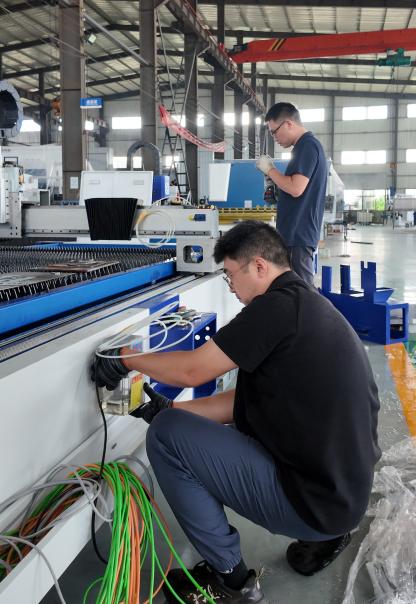
Verify that all wiring harness connectors are fully inserted and locked tightly. Inspect each cable for outer layer cracking and damage, loose plug terminals, oxidized metal contact surfaces and aging wear marks—these hidden troubles will interfere with normal electrical conduction and reduce overall equipment reliability.
Step 5: Real-Time Supervision of Equipment Running Temperature
Check whether all heat dissipation fans and cooling assemblies of JUGAO equipment rotate smoothly and deliver unobstructed air circulation. If the machine is fitted with thermal detection sensors or temperature monitoring tools, make full use of them to find high-temperature hot spots at an early stage, so as to avoid irreversible thermal fatigue damage to precision circuit elements.
Step 6: Post-Maintenance Functional Debugging and Test Run
After finishing all maintenance items, restore power connection and run a full set of test cutting procedures. Confirm that each circuit control module operates normally without error alarms or intermittent operation failures.
Long-Term Stable Operation Guidelines for JUGAO Circuit Boards
1. Formulate Fixed Cyclical Maintenance Plans
Draw up a standardized recurring maintenance plan covering regular visual inspections, deep cleaning and equipment performance tests. Timely troubleshooting can stop minor defects from evolving into major breakdowns that halt production.
2. Standardize Anti-Static Component Handling Specifications
All staff must follow complete anti-static operation standards when touching circuit boards. Direct contact with electronic chips and components with bare hands is forbidden, to avoid electrostatic discharge (ESD) permanently damaging precision circuit structures.
3. Keep The Whole Working Area Dust-Free
Maintain a clean state for the JUGAO laser cutting machine body and its surrounding workshop area. Clear away floating dust, iron cuttings and all kinds of processing waste on a daily basis, forming a dust-proof barrier to protect internal circuit boards from contaminant erosion.
Frequently Asked Questions
What’s the reasonable maintenance cycle for JUGAO laser cutting circuit boards?
We suggest carrying out surface visual inspections once per month, while performing thorough deep cleaning every 3 to 6 months. The exact cycle can be adjusted flexibly according to daily machine load and workshop dust concentration.
Will continuous high temperature cause irreversible damage to circuit boards?
Absolutely yes. Repeated overheating circulation will accelerate solder joint aging and degrade electronic component performance permanently. Consistent temperature monitoring and routine maintenance of cooling systems are mandatory protective measures.
What dedicated tools are needed for daily circuit board upkeep?
Daily routine maintenance only requires three basic supplies: anti-static soft brushes, dry compressed air tanks and ESD insulating gloves. These tools can satisfy most daily inspection and cleaning demands for JUGAO circuit boards.
Closing Remarks
Scientific and standardized maintenance of circuit boards is a must for JUGAO laser cutting machines to maintain high machining precision, reliable daily operation and extended service life. By sticking to periodic visual inspections, standardized cleaning workflows and comprehensive preventive detection items, workshop operators can drastically cut production downtime, skip expensive component replacement costs and sustain consistent high-quality cutting output. If you need in-depth professional maintenance guidance or one-on-one technical support, reach out to the JUGAO after-sales technical team at any time to keep your laser cutting equipment running at optimal efficiency.

