





How Servo-Driven Sheet Followers Enhance Quality and Efficiency in CNC Press Brakes
In the field of sheet metal processing, servo-driven CNC press brakes are emerging as key equipment driving the industry's intelligent transformation. As manufacturing demands for processing precision, production efficiency, and automation levels continue to rise, traditional bending methods struggle to meet modern production needs. By achieving precise synchronization between material support and the bending action, servo-driven press brakes effectively solve deformation issues—such as sagging caused by gravity—when handling long, thin, or heavy workpieces, thereby significantly improving processing quality and production efficiency.
I. Servo-Driven Sheet Follower: The Core Component for Solving Large Workpiece Bending Challenges
The servo-driven sheet follower is one of the most critical functional components of a servo-driven CNC press brake, playing a particularly significant role when processing long or thin sheets. When a CNC press brake processes long or heavy workpieces, the material tilts upward as the dies close; without effective support, excessively heavy or long sheets are prone to bending deformation due to gravity, which severely compromises bending accuracy. Driven by servo motors and featuring a wide support surface and high load capacity, the follower unit ensures the support plate moves in tandem with the sheet throughout the bending process. Through the precise coordination of linear and rotational movements, the follower's trajectory and speed are perfectly synchronized with the sheet's upward movement and bending speed. This ensures bending accuracy while drastically reducing the difficulty and labor intensity associated with manual material support.
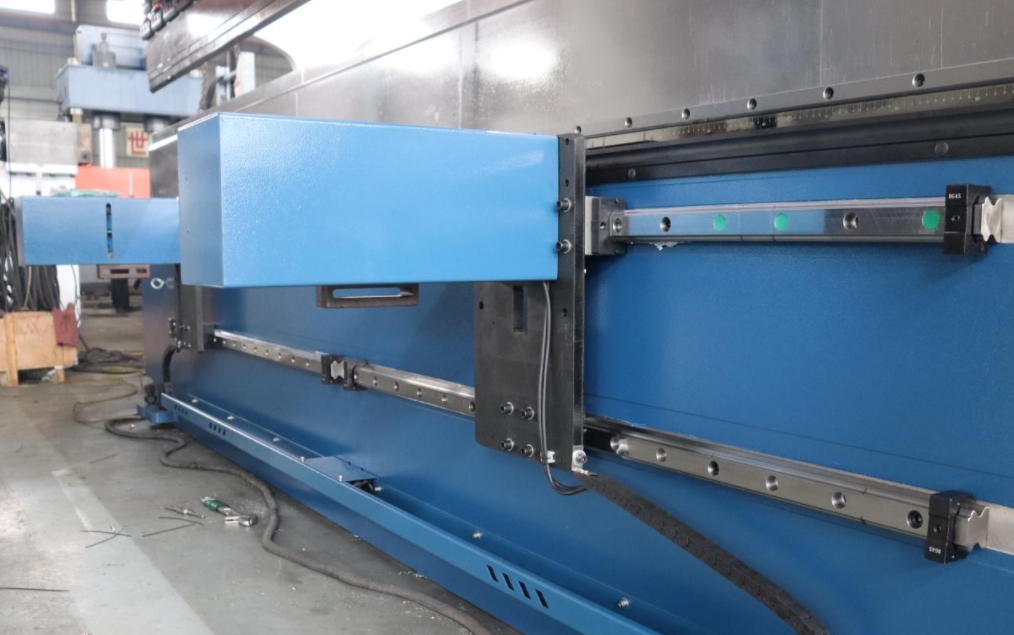
The servo-driven sheet follower unit independently developed by JUGAO CNC MACHINE utilizes a dedicated electrical control system. It employs magnetic scales for real-time position feedback, with a computer controlling the servo motor in a closed-loop system to execute the following motion. The unit features a standalone structure that requires no modifications to the press brake's mechanical components; equipped with leveling casters, it offers flexible mobility and is compatible with press brakes of any brand or model. The support table features universal ball transfers to facilitate the movement and rotation of workpieces. Its height can be finely adjusted to accommodate molds of varying heights, and the speed of the following support mechanism can be flexibly adapted to the sheet thickness—all without requiring modifications to the press brake's original control system. This highly flexible design allows the following support system to quickly integrate with various press brakes to form semi-automated production lines, enabling rapid prototyping and batch production while saving labor and delivering strong economic benefits.
II. Auxiliary Following Support for Bending: An Intelligent Upgrade from Semi-Automation to Full Automation
Within the technical framework of CNC press brakes with following support, the auxiliary following support system is a critical component for achieving fully automated bending. Traditional front following support mechanisms often utilize crank-linkage mechanisms driven by electro-hydraulic servo control; they rely on the CNC system to regulate the opening of proportional servo valves—and thus the oil flow into the cylinders—to synchronize the support's movement speed with the sheet metal's bending speed. Such mechanisms involve complex mechanical actions, require electro-hydraulic control via cylinders, entail high manufacturing costs, and present challenges in controlling movement trajectories. To address this, JUGAO CNC MACHINE has abandoned hydraulic control in its new generation of CNC servo-electro-hydraulic press brakes. Instead, the company employs servo motors to directly drive mechanical movements, with the CNC system coordinating parameters across all servo motors to ensure precise synchronization of related actions.
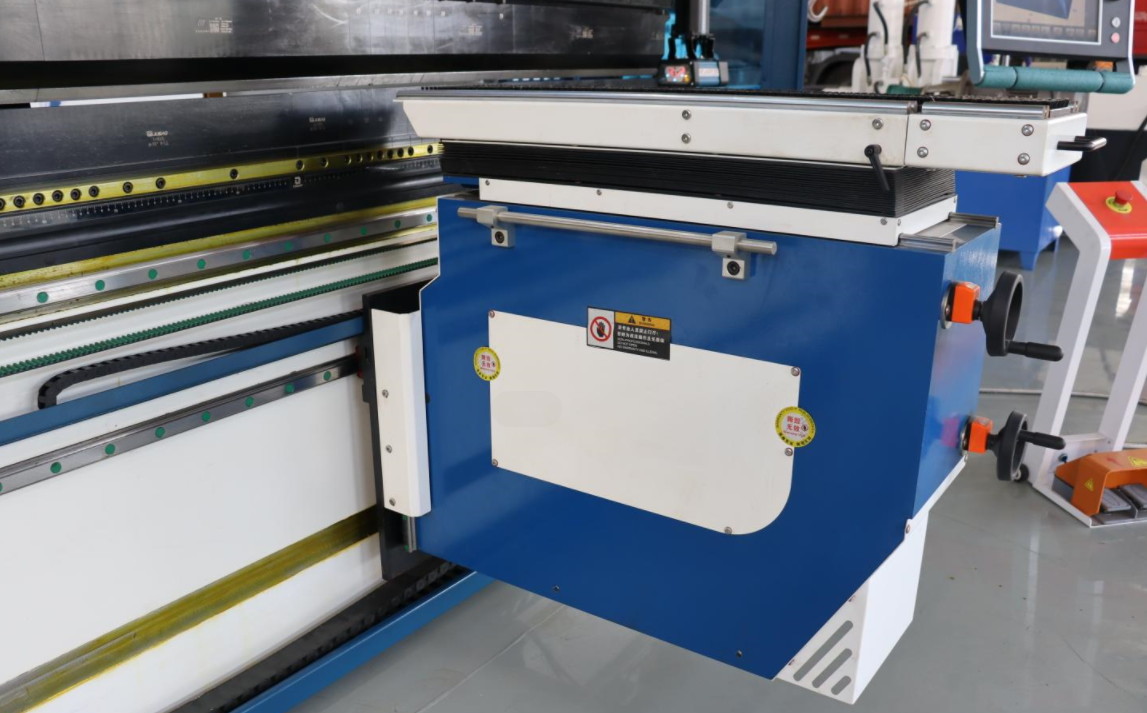
The auxiliary following support system can be flexibly configured to meet diverse bending process requirements. Based on control methods and connection styles, front following supports are categorized into integrated units and floor-standing units (i.e., bending follower carts). Integrated front following supports are mounted on the press brake's lower beam, slide horizontally along the Z-axis, and are controlled directly by the press brake's CNC system. In contrast, floor-standing units feature an independent outer frame and base structure; they can be moved to the workstation on rollers and secured via adjustable feet. Equipped with their own programmable controllers, these units offer greater versatility. The core advantage of the auxiliary following support system lies in its independence and flexibility: it requires no modifications to the press brake and draws no signals from the press brake's electrical cabinet, allowing it to be easily moved and paired with different press brakes as needed.
III. Robotic Follow-up Bending: The Ultimate Form of Unmanned Production
As the sheet metal manufacturing industry advances toward automation and intelligence, robotic follow-up bending technology is emerging as a cutting-edge application for CNC follow-up bending machines. In automated sheet metal bending, the robot must precisely track the bending machine's feed speed and trajectory in real-time; otherwise, even minute tracking errors can significantly compromise bending accuracy or cause workpiece deformation. The core of this technology lies in establishing a synchronization control strategy between the robot and the bending machine, enabling the robot's end-effector to move precisely along the sheet's bending path.
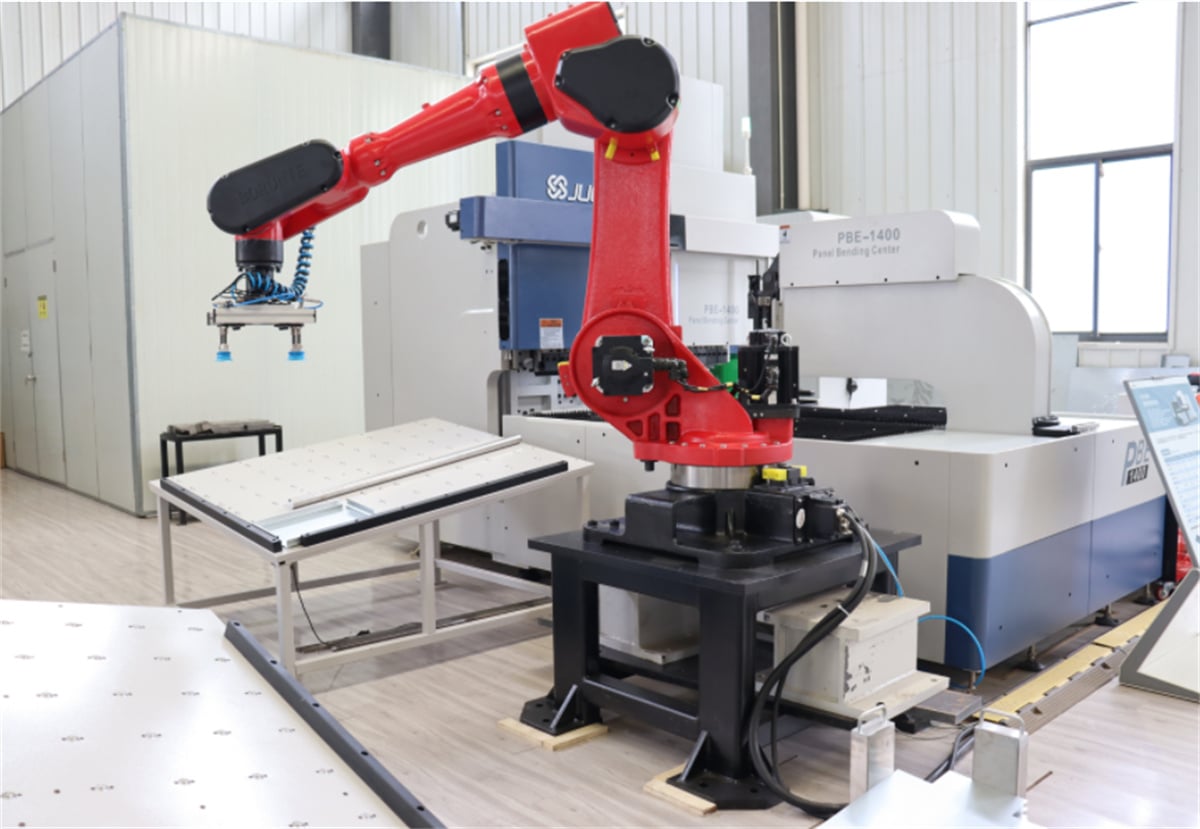
In robotic follow-up bending scenarios, the robot must synchronously support the sheet as the bending tool moves, preventing deformation caused by gravity during the process. JUGAO CNC MACHINE’s bending follow-up unit—a floor-mounted front support device—features an independent control system that allows it to work with any bending machine on the shop floor, providing flexible and reliable support for robotic follow-up systems. By organically combining follow-up material support with robotic follow-up bending technology, sheet metal fabricators can achieve a phased upgrade: transitioning from manual support to semi-automated assistance, and finally to fully automated, unmanned production.
Conclusion
From basic follow-up material support and auxiliary follow-up systems to advanced robotic follow-up bending technology, CNC follow-up bending machines are redefining the boundaries of precision and efficiency in sheet metal processing. As a key driver in this field, JUGAO CNC MACHINE leverages continuous innovation in CNC bending machines, follow-up support devices, and automated bending solutions to provide reliable equipment for industries such as home appliances, elevators, defense, construction machinery, boilers, and shipbuilding. Whether addressing the challenges of bending large or thick workpieces or advancing toward a future of fully automated, unmanned production, JUGAO CNC MACHINE’s follow-up bending machines and supporting technologies will continue to help manufacturers enhance their core competitiveness and progress steadily along the path of intelligent transformation.

