





Sheet Metal Punching vs. Stamping: Selecting the Optimal Fabrication Strategy
Selecting between industrial punching and press stamping appears straightforward on the surface, yet this core engineering choice dictates part unit costs, edge finishing, and overall production efficiency. To help fabricators make fully informed equipment decisions, JUGAO presents this comprehensive comparative analysis. Below, we evaluate the underlying mechanisms, operational protocols, and economic trade-offs of both methods to align with your component geometry, annual volume requirements, and capital budget.
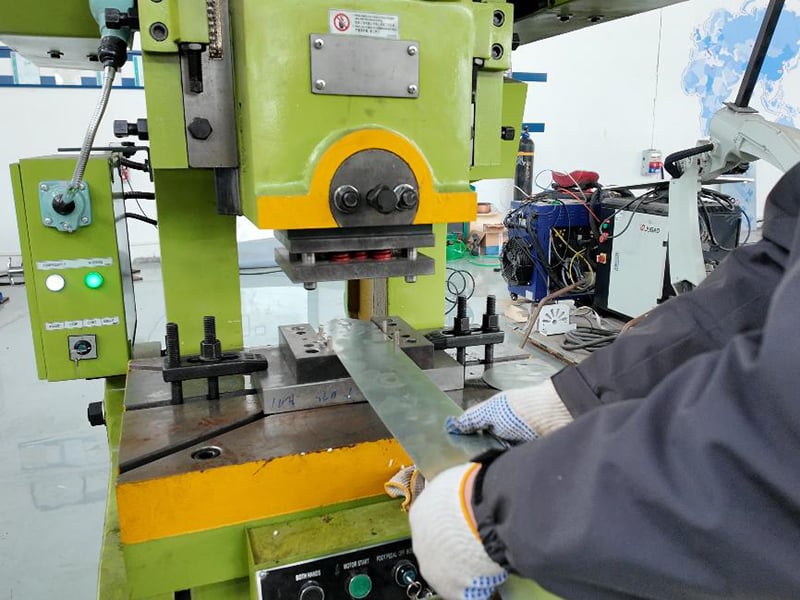
1. Understanding the Punching Process Mechanics
Sheet metal punching is a localized shearing process that removes defined geometric contours from sheet material using high-tonnage impact applied via a matched punch and die setup. As the upper tool penetrates the workpiece, the severed material—referred to as the scrap slug—is ejected through the lower die cavity. This technique provides an extraordinarily efficient method for creating uniform perforations, slots, and cutouts across sheet metal.
2. Punch Press Setup and Operational Sequence
Prior to commencing a production batch, operators must carefully position the raw sheet metal on the machine bed. The technician selects the appropriate punch-and-die tooling set corresponding to the target hole dimensions, mounts them securely into the turret or press head, and verifies die clearance relative to substrate thickness. Precise alignment is essential to eliminate excessive burring and guarantee uniform hole quality.
3. Typical Applications for Industrial Punching
Industrial punching is best suited for producing standardized, repeating geometric cutouts—such as chassis ventilation grids, fastener mounting holes, and structural cutouts—at rapid speeds. It is particularly effective when working with mild steel, aluminum alloys, and stainless steel up to moderate thickness, where minimizing cycle time per feature is paramount.
4. Exploring the Metal Stamping Process
Metal stamping serves as an overarching classification for comprehensive forming techniques, including shallow bending, surface embossing, edge flanging, coining, and progressive piercing. Utilizing heavy-duty die sets mounted in high-tonnage mechanical or servo presses, stamping permanently shapes flat sheet stock into complex three-dimensional geometries in high-volume manufacturing environments.
5. Tooling Changeover in Stamping Operations
Transitioning a stamping press between distinct operations—such as blanking, deep drawing, or progressive forming—requires a rigorous die changeover routine. This involves hoisting and clamping heavy multi-station die sets onto the press bolster, calibrating shut-height and ram stroke depth, and performing trial sample runs to confirm dimensional fidelity before authorizing full-scale production.
6. Primary Industrial Stamping Applications
Stamping demonstrates clear technical superiority when manufacturing intricate, multi-dimensional components like automotive structural panels, deep-drawn enclosures, and complex mounting brackets. Because multiple cutting and forming steps can be integrated into a single press stroke, stamping significantly minimizes secondary assembly steps while maintaining tight dimensional tolerances.
7. Key Technical Differences: Punching vs. Stamping
A. Component Geometric Complexity
· Punching: Concentrated on creating flat, two-dimensional cutouts, holes, and edge contours.
· Stamping: Capable of piercing, bending, drawing, and embossing complex 3D profiles simultaneously.
B. Tooling Capital and Lead Times
· Punching: Standardized modular tooling with lower initial costs and rapid setup turnaround.
· Stamping: Custom-engineered compound or progressive dies requiring substantial initial capital investment and longer fabrication lead times.
C. Speed and Throughput Capabilities
· Punching: Highly efficient for high-speed hole pattern generation across variable sheet layouts.
· Stamping: Unmatched production output for medium-to-large production runs of uniform finished components.
D. Stock Thickness and Alloy Strength
· Punching: Generally optimized for light-to-medium gauge sheet metals within standard tonnage limits.
· Stamping: Accommodates heavy-gauge plates, high-strength structural alloys, and severe deformation cycles.
Comparative Parameter Summary
| Evaluation Metric | Piercing/Punching | Press Stamping |
| Tooling & Die Capital | Low to Moderate Initial Outlay | Substantial Initial Investment |
| Production Cycle Speed | Moderate Throughput | Extremely High Speed |
| Tooling Changeover Time | Rapid (Minutes) | Extended (Hours to Days) |
| Edge & Cut Quality | Good (May require deburring) | Exceptional (Fine-blanking quality) |
| Recommended Batch Size | 1,000 to 10,000 units/month | 10,000+ units/month |
8. Frequently Asked Questions (FAQs)
Q: Can a single press frame perform both punching and stamping tasks?
A: Yes. Many modern hydraulic and servo presses feature universal bed bolsters and modular quick-change systems, allowing operators to swap punching turrets for forming dies on the same machine frame, provided total press tonnage meets operational requirements.
Q: What procedures help minimize burr formation during punching operations?
A: Burr formation is controlled by optimizing die clearance according to sheet thickness, maintaining sharp punch cutting edges through regular re-grinding, and selecting appropriate shear angles on the tool face.
Q: Which metal grades are recommended for stamped automotive components?
A: High-Strength Low-Alloy (HSLA) steels and ductile aluminum series (such as 5052 and 6061) are standard choices. Their excellent yield strength and formability prevent cracking during deep drawing and complex bending sequences.
9. Conclusion
Determining whether punching or stamping is right for your project depends on part complexity, target production run, and tooling budget. For standardized hole patterns, rapid iteration, and lower upfront costs, punching remains the optimal path. When your designs call for three-dimensional contouring, embossing, or multi-stage forming at high volume, press stamping provides superior throughput and cost efficiency per piece. For expert technical guidance, custom machine configurations, or tooling consultation, contact the JUGAO engineering team today to optimize your sheet metal processing workflow.

